What Happened
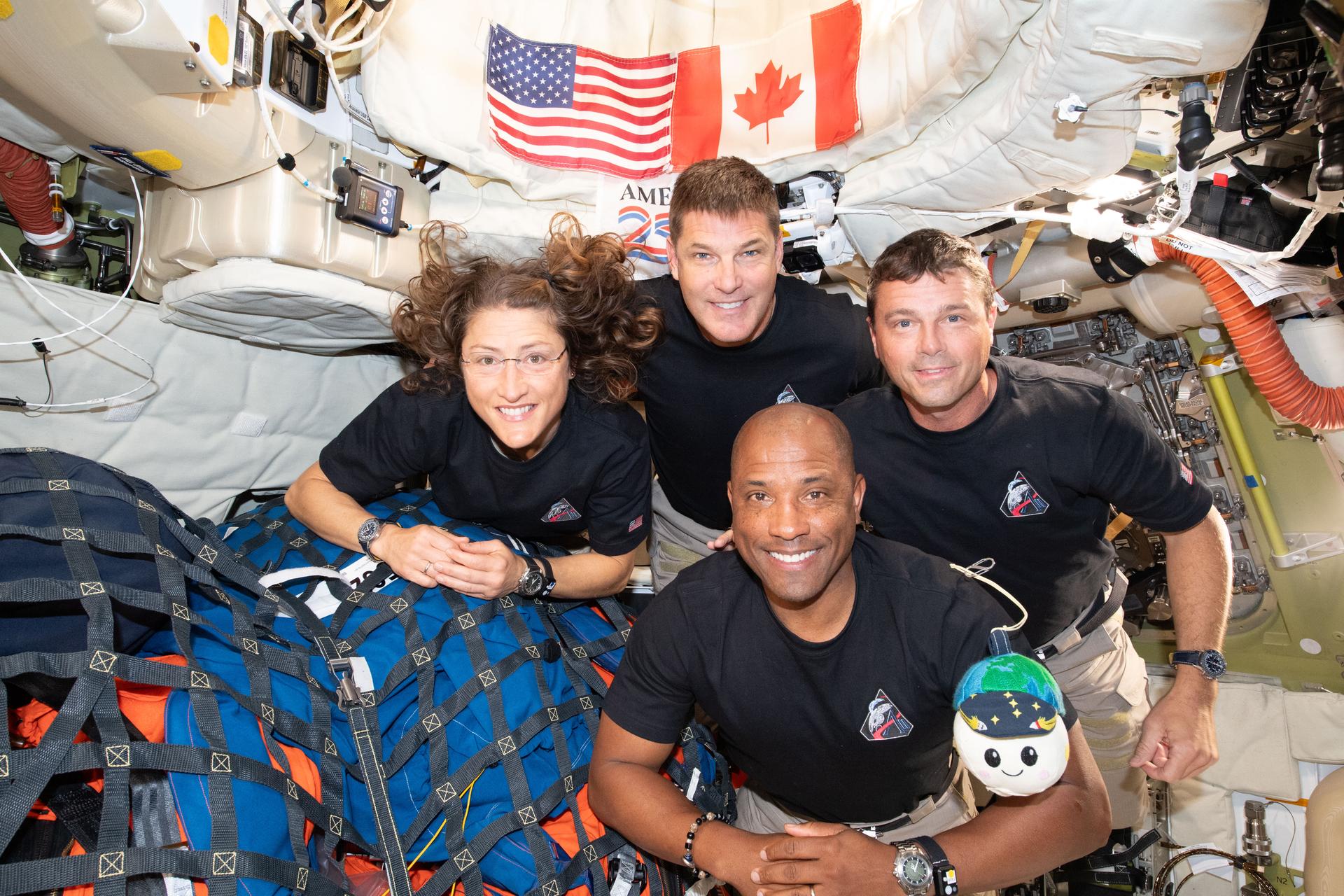
art002e013365 (April 7, 2026) – The Artemis II crew – (clockwise from left) Mission Specialist Christina Koch, Mission Specialist Jeremy Hansen, Commander Reid Wiseman, and Pilot Victor Glover – pause for a group photo with their zero gravity indicator “Rise,” inside the Orion spacecraft on their way home.
Table of Contents
Why It Matters
Following a swing around the far side of the Moon on April 6, 2026, the crew exited the lunar sphere of influence (the point at which the Moon’s gravity has a stronger pull on Orion than the Earth’s) on April 7, and are headed back to Earth for a splashdown in the Pacific Ocean on April 10.
Key Details
- NASA’s Human Research Program (HRP) uses research to develop methods to protect the health and performance of astronauts in space.
- In support of NASA’s goals for long-term missions on the surface of the Moon and human exploration of Mars, HRP is using ground research facilities, the International Space Station, and analog environments to monitor human health in deep space. NASA’s Artemis II mission was the first crewed mission to the vicinity of the Moon since Apollo 17 in December 1972.
- The mission carried four astronauts aboard the Orion spacecraft on a trajectory into deep space – farther than any humans have gone before – marking a pivotal milestone in the history of human exploration.
- For the first time in more than half a century, human beings experienced the full physiological and psychological conditions of space travel beyond low Earth orbit, including an environment with space radiation, the isolation and confinement of a new spacecraft, and the operational demands of a test mission profile. For HRP, Artemis II represents an irreplaceable research opportunity.
Background Context
art002e013365 (April 7, 2026) – The Artemis II crew – (clockwise from left) Mission Specialist Christina Koch, Mission Specialist Jeremy Hansen, Commander Reid Wiseman, and Pilot Victor Glover – pause for a group photo with their zero gravity indicator “Rise,” inside the Orion spacecraft on their way home. Following a swing around the far side of the Moon on April 6, 2026, the crew exited the lunar sphere of influence (the point at which the Moon’s gravity has a stronger pull on Orion than the Earth’s) on April 7, and are headed back to Earth for a splashdown in the Pacific Ocean on April 10. NASA’s Human Research Program (HRP) uses research to develop methods to prot
What To Watch Next
Track official statements, independent verification, and regional impact updates in the next 24 to 48 hours.
Editorial Next Step
Add your local context, fact checks, quotes, and analysis before or after publication.
Source: NASA – Original Link
Source: NASA